
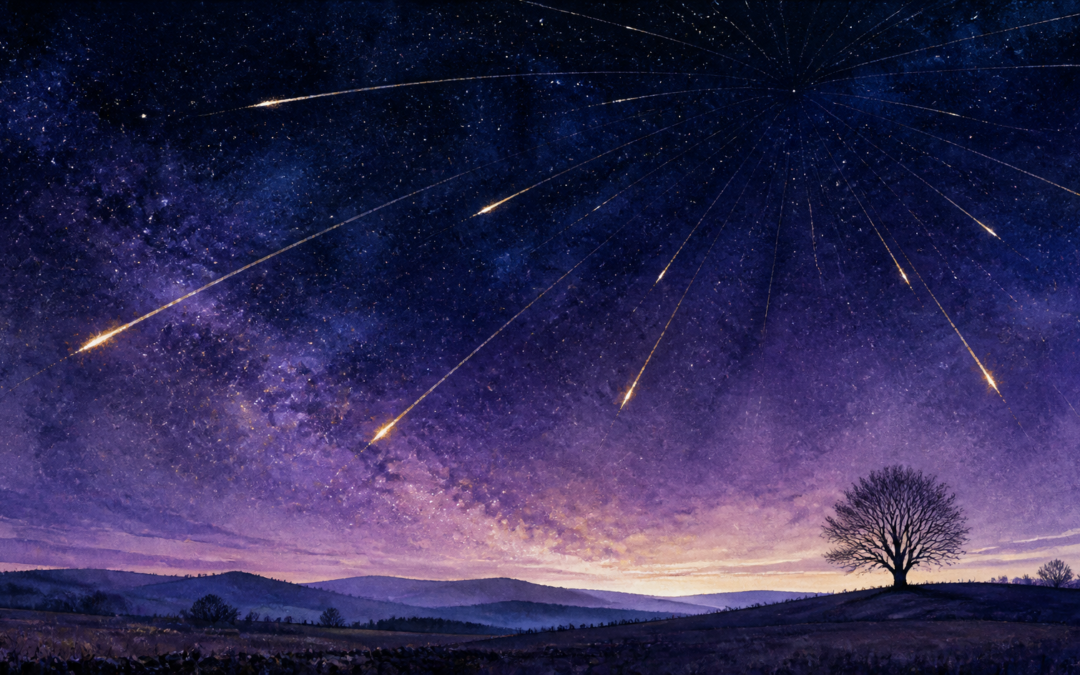
There’s something about a shooting star that makes almost everyone stop. Conversations pause. People point. For one bright second, the whole sky feels close.
This month, you have the chance to see dozens of them. The Leonid meteor shower is back, and on a clear night it can turn an ordinary walk to the bins into a small moment of wonder. Here’s what the Leonids are, when and where to look, and how you can watch them with me, even if the clouds have other ideas.
What are the Leonids?
Every November, the Earth passes through a trail of dust left behind by a comet called Tempel-Tuttle. When those tiny specks hit our atmosphere, they burn up as streaks of light: meteors, or shooting stars.
Many of them are no bigger than a grain of sand. But they arrive at up to 71 kilometres a second, among the fastest of any meteor shower, so Leonids are quick and often bright, sometimes leaving a faint glowing trail behind them.
They’re called the Leonids because they all seem to pour out of one part of the sky: the constellation of Leo, the lion. Trace any Leonid backwards and it points to the lion’s head, a hook of stars called the Sickle.
And once in a while, they put on a show nobody forgets. In November 1833, people across North America woke to a sky so full of falling stars that some described it as snow made of light. Astronomers estimate there were around 100,000 an hour. That night helped begin the scientific study of meteors.
When to see them in 2026
- The season: 6 to 30 November.
- The peak: the night of Tuesday 17 into Wednesday 18 November.
- How many: around 10 to 15 an hour at the peak, from a properly dark place. Fewer from towns, and fewer away from the peak, but you can catch some on any clear night.
- The Moon: on the peak night it sets just before midnight, so the hours after midnight are dark. That’s good news.
- The best time: after midnight, until dawn starts to lighten the sky at around 5.30am. Leo rises in the east-north-east at about 10 to 10.30pm and climbs higher as the night goes on.
No storm is expected this year. But the Leonids don’t need to storm to be lovely.
Where to look, and how to watch
The good news is that you don’t need any equipment at all. Your eyes are the best tool you have, because they take in so much of the sky at once.
- Find somewhere dark, away from street lights, with a wide view of the sky, especially to the east and south.
- Wrap up warmly. Hat, gloves, a blanket, a flask. You’ll be still for a while.
- Lie back on a reclining chair or a mat, and look about halfway up the sky, a little to one side of Leo. Meteors further from Leo have longer, more beautiful trails.
- Give your eyes 20 minutes to adjust, and keep your phone screen away. Each glance at a bright screen resets your night vision.
- Be patient. Give it at least half an hour. Meteors come in their own time, sometimes two at once, sometimes none for a while.
To find Leo yourself, start with the Plough, high in the north-east after midnight. Take the two stars of its pan nearest the handle, follow the line from the top one down through the bottom one, and keep going a long way. You’ll arrive at a backwards question mark of stars with a bright star at its base. That’s Leo’s Sickle, and Regulus, “the little king”.
Try this while you read · A gameCounting SheepHelp the sheep over the fence and count them as they go. Three bumps and the flock goes to bed. How many can you count? Share…Start counting →I love this about meteor watching: it asks you to slow down. You can’t rush it, and you can’t make it happen. You just lie back, breathe, and let the sky come to you. Which, if you think about it, is very close to what trance feels like.
Watch the Leonids with me: Leonid Night Watch
That’s why I’ve made something special for this month. Leonid Night Watch opens on Friday 6 November, the night the shower begins, and it’s a stargazing trance you can enjoy whatever the weather.
You choose where to watch from: a quiet rooftop, a hilltop, or your own back garden. Then we spend a night under the November sky together. Your eyes adjust to the dark, one slow breath at a time, as more and more stars appear. You trace the constellations, each with a true story and a calm thought to keep. And then we count the meteors down, twenty to one, letting each one carry you a little deeper. Catch a golden fireball, and you can make a wish.
At the end, you can wake up refreshed, or let yourself drift off to sleep. And you can keep a picture of your own night sky, wishes and all.
Three ways to watch
Free. The whole night is yours, at no cost: about twenty minutes of eyes adjusting, five constellations, twenty meteors counted into a deep calm, three golden wishes, and a guide to seeing the real Leonids.
The Full Sky, £4.99. All twelve constellations of the November sky, each with its own short trance. Peak Night, from 17 November: the true story of the great storm of 1833, and a longer, deeper trance as the sky fills with meteors. Sleep Under the Stars, a sleep trance with a sky that fades with you. Geminid Night in December, for the year’s richest shower. My voice guiding you, a printable Field Guide and Night Journal for watching the real sky, recordings to keep, and it’s yours all year, including next November.
The Deluxe Night Watch, £9.99. Everything in the Full Sky, plus the Sky Compass: tell it where you are, hold your phone flat like a compass, and it shows you which way to turn and how high to look to face the real Leonids, with the best times to watch from where you live. You’ll also get A Night Under the Leonids, a full-length recording to download and keep, and three phone wallpapers of your own night sky.
If you’re a member of the Dreamweave Circle, the Deluxe Night Watch is already yours. Just log in.
A little stillness under the stars
Whether you’re outside under a dark sky on the seventeenth, or tucked up indoors with Leonid Night Watch, I hope you find a moment of stillness this month. Every meteor you see is a speck of dust that travelled for hundreds of years, burned for a single second, and lit up the whole sky.
You don’t have to be big to shine. You only have to be here.
Begin Leonid Night Watch, free, from 6 November. Until then, the link shows a countdown.
With love, Jessica